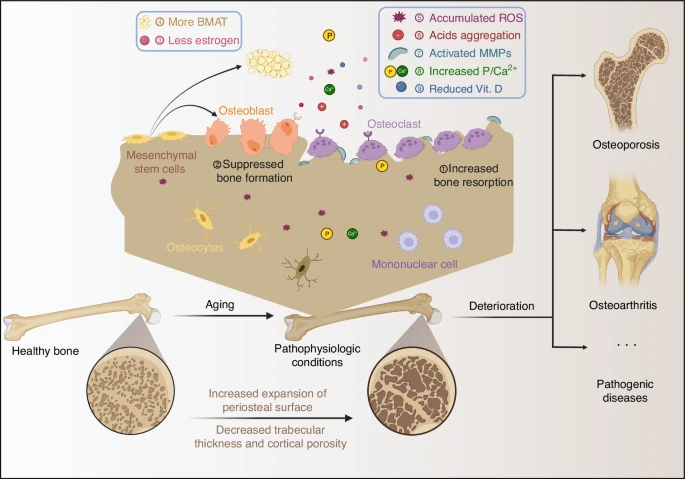
Skeletal aging associated with diverse age-related disorders is increasing due to unhealthy diets, stressful lifestyles, and rapid aging. Repair and regeneration of aging skeletons are a global issue. Despite the self-healing ability of bone and the availability of various treatment strategies, degenerative bone repair and regeneration face significant problems due to unbalanced bone remodeling and a lack of active treatment strategies. The development of smart materials has created opportunities for degenerative bone repair and regeneration. The smart materials are responsive to endogenous/exogenous stimuli with tailored structure and function, which can promote skeletal aging repair and regeneration. Thus, in this study, skeletal aging is recognized as the progressive state that begins from peak bone mass to pathophysiological state and disorder conditions. We have introduced and characterized skeletal aging from the perspectives of cell-matrix-microenvironment and macrostructure-function-mechanical properties, for which systemic smart drug delivery systems and local smart scaffolds are designed. The smart drug delivery systems undergo conformation change and phase transition upon stimuli to release drugs at time- and site-specific to promote aging bone repair. Smart scaffolds with versatility and mechanical strength can replace bone defects to provide a tissue repair and regeneration microenvironment. Endogenous disease microenvironments and/or external physical triggers stimulate scaffold activation, which release bioactive factors to accelerate bone regeneration. This manuscript discusses the manufacturing techniques of these smart materials and presents key challenges and future directions for clinical translation, emphasizing their potential for personalized treatment and targeted therapy of skeletal aging.
Smart biomaterials for skeletal aging repair and regeneration